
Painter Paul Lemmon takes viewers 'through the screen' in museum show
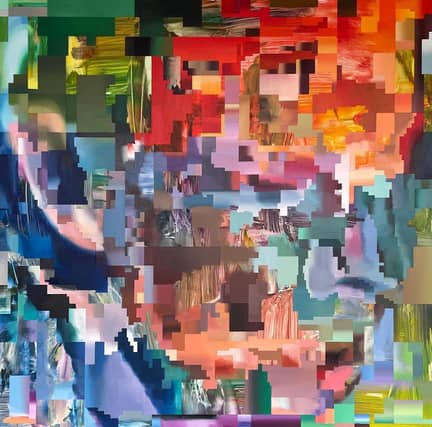

In his major solo show at the Herbert Art Gallery & Museum in Coventry, Paul Lemmon interrogates our relationship to the online realm, from social media and screen exposure to wider internet culture and the promises of algorithms.
All based on digital videos of film, TV and social media, which Lemmon disrupts and remixes, more than 40 handmade paintings foreground the illusory effects, and shapeshifting qualities, of the internet and screen culture.
The show begins with a series of 10 oil paintings of various sizes for which the artist downloaded and corrupted YouTube footage for his source material. Within these fragmented compositions, defined by their digital collage aesthetic,can be glimpsed the phantoms ofindividuals speaking to camera.
In this series, the artist has investigated the experiences of people communicating through a screen. As he explains, “it seems like it’s connecting us but, really, forms a barrier. It’s not possible, for instance, to look someone in the eye when we talk to them through a camera on Zoom. The screen creates disconnection, and the disrupted video effect serves as an analogue for this feeling.”
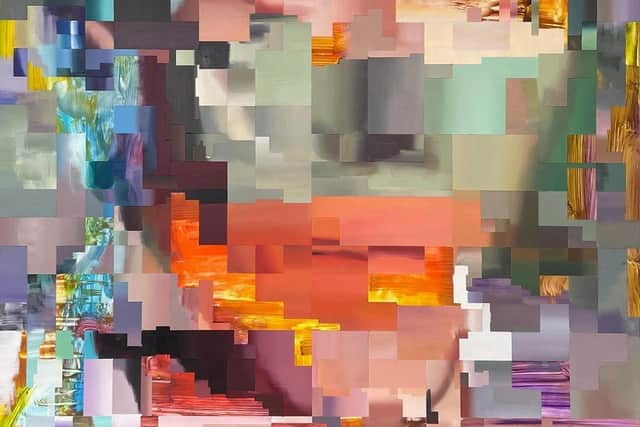
The glitch dynamic also acts, in the artist’s words, “as a metaphor for the masks we wear, and personas we assume for social media, as if splintering and fracturing our personality”. He reflects the ways in which we often perform for lives which are lived out on screen, rather than in reality.
As well as depicting anonymous figures, Lemmon has turned his attention to the historical faces of cultural icons from a certain pre-internet era – political figures like Richard Nixon, and pop stars such as Madonna and Debbie Harry.
Among the show’s highlights and the largest on display, ‘Beyond the beyond’ (2024) is a powerful example of the abstracted works Lemmon calls ‘cyberscapes’. The source material for this painting was David Bowie’s ‘Life on Mars?’ promo, which the artist has distorted beyond recognition. If viewers stare long enough they might just discern the singer emerging from the patchwork surface. Bowie also appears across 6 more paintings, part of another series from a special New Year 1979 performance of ‘Space Oddity’.
Lemmon explores the ways in which we see culture through the lens of the internet: “Footage that was once broadcast and only accessible on live TV, or on DVD or video cassette is now watchable (exclusively often) through the internet, which has the curious result of flattening time. It makes all culture reachable but has collapsed it into one big mass.” In turn, this creates an ocean of visual content and information, which can be overwhelming.
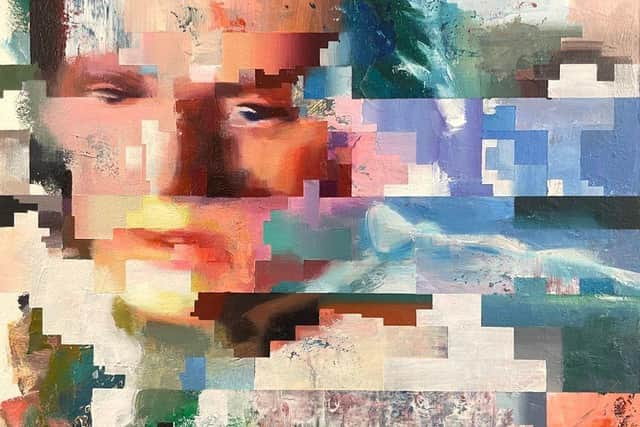
But there’s also beauty to be derived from the depths of internet culture, which Lemmon frames in paintings such as Wonderground (2024), another cyberscape where layers of colour twist and transform in mesmeric pixel patterns. For this show, he’s explored the idea of cyberspace as a sublime and shimmering landscape that surrounds us. As he says:
“I've ventured into the digital forest to create something that's aesthetically beautiful, like a woodland or bed of roses, turning the algorithms’ black box into visions of colour and light.”
Alongside the paintings, he has included abstract animations, showcasing the corrupted video sequences that he creates as a crucial part of his artistic process. For Lemmon, technology is integral to his work, not only as a subject, but as a tool in itself, wherein he questions both its positives and negatives, while painting a vision that is unique to the 21st century:
“What I paint is only possible because of the internet, computers, and the algorithms which compress videos so they can be transmitted to your phone. Yet, the promise and allure of this technology can end up devaluing real-life things, including the physical act of painting and the human endeavour that goes into it.
By disrupting the computer’s own processes for my compositions, I’m using technology in way that it’s not supposed to be used, and that's art. I’m travelling into the screen and returning with what I find there. With oil paint I’m taking the digital, immaterial and making it real again, to give the viewer the pleasure of reality. My message for viewers is to stay with real life as much as possible.”
Using the familiar visual language of the digital screen, Lemmon seizes the attention of his viewers but encourages them to spend time in ‘slow looking’, immersed in the intricately arranged shapes and colours on the tangible, physical surface of his oil paintings. As he points out:
“My paintings look like screens but they don’t behave like screens. The power doesn't run out, they don't change or need software updates, have no notifications or logins, and can't be downloaded or switched off. There’s a sense of truth about a painting – it has substance, gravity and presence, it’s consistent and reliable.”
In his solo show, Through the Screen, Paul Lemmon ultimately offers viewers a valuable reconnection to the physical world, where they can enjoy the sensory experience of viewing art, made by human hands.