
Review: Playbox Theatre wrests beauty out of violence

Electra is a thrilling exploration of familial conflict taken to extremes
Among the great plays of Western Europe, Electra, by Sophocles, written around 420 BCE, stands out as a drama of particular ferocity and complex psychological insight. It has been performed many times by high-profile directors and companies, but Warwick’s exceptional theatre for young people, Playbox Theatre, has breathed new life into the old play, and presented it with a raw energy that holds the audience in its vice-like grip from start to finish.
Electra (Eve Hatz) is the daughter of mythological figures, Agamemnon (Jack Hobson) and Clytemnestra (Lucy Griffiths). Prior to the play’s action, Agamemnon has killed his own daughter Iphigenia (Millie Taylor) as a sacrifice to the goddess Artemis (voiced by Sinead Keenan) to ensure good winds to drive his Greek fleet towards Troy. Iphigenia’s mother, Clytemnestra, kills Agamemnon in an act of revenge for which her daughter Electra and her son Orestes (Conor Davis) cannot forgive her.
In Greek mythology, a murder within the family or tribe must be avenged by another murder, which threatens an ever-spiralling descent into a hell of killing that may never end. It’s the sort of thing we have seen all too often played out in reality. Electra and her brother are not worried by that awful fate; their aim is solely revenge, the righting of a wrong. The fact that Agamemnon had acted under orders from a goddess is no excuse.
Director Emily Quash has done a marvellous job in combining the slightly static, argumentative nature of Greek drama with visceral scenes of violence graphically enacted right in our faces on the in-the-round stage and made it not the gore-fest it could have been but a thrilling, dynamic, relentless piece of drama with plenty of room for complex emotions.
The violence is beautifully staged. Agamemnon and Clytemnestra are each part-drowned, and we get full-on immersion. Blood is coughed up by central figures and Chorus alike. There is a lot of shouting. But never does the strength of the action take over as spectacle from the emotional core at the heart of the story.
Eve Hatz gives an astonishing performance as Electra. She may be an angsty teenager with a dangerous father complex, insensitive to opinions other than her own, but she is vibrantly alive and believable in her hatred of her mother and her desire for justice. There is no love lost between her and her mother, but at the same time one can feel the conflict within Clytemnestra’s breast.
The Chorus is made up of many voices, each somehow managing to maintain an identity of their own. Projection throughout was crystal clear on the big stage. I have to mention the youngest, Beckett Mitchell, as the child, Orestes. He looked about five or six years old, yet in his small but crucial role he held the stage, and not only for his obvious youth. If talent is innate, he could be one to watch.
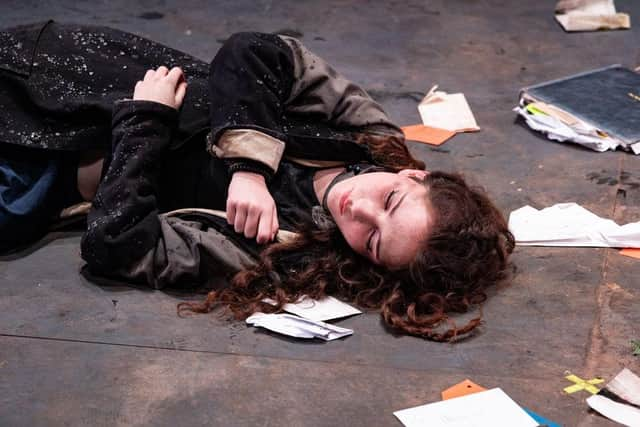
Did the cast suffer trauma in the making of this play? I don’t know, but Playbox is so experienced at managing and delivering high-octane theatre that I’d trust the support they’d give. Electra is a demanding play on every level, and not a comfortable piece of entertainment. But after nearly three thousand years and numerous adaptations it still manages to connect with something deep inside us. Its horror is cathartic in a way that many lesser works are not.
As always with Playbox, I wish that the run had been longer, because three shows just isn’t enough to give the theatre-going world what it deserves.