
Women ultimately have power in the RSC’s mythical interpretation of The Winter’s Tale
This is a radical, obliquely myth-infused interpretation of Shakespeare’s late comedy.
The Winter's Tale is a visually stunning, full-on evocation of a society ruled by a fickle and neurotic tyrant, Leontes (Bertie Carvel) who imagines that his wife Hermione (Madeleine Appiah) has been having an affair with his best friend Polixenes (John Light), King of Bohemia, while staying as his guest. True, the two are close, but not even a proclamation from the gods via the Delphic Oracle can convince him of his mistake. We have seen, and are seeing, states ruled by powerful, insecure men, and in this sense this fantastic tale has its feet firmly on the ground of reality.
The mythical elements are writ large right from the start. Hanging over the dark, mist-infused stage is a giant globe. At times it might be the moon, but for much of the play it more closely resembles a crystal ball, its link to the future present but obscured by swirling clouds.
The production makes no attempt to play nice. Leontes’s fury is unrestrained, his awful mistreatment of his wife unremitting and merciless. There are scenes, such as when he throws his new-born baby daughter to the ground, that are as shocking (and beautifully timed) as any bloody scene of warfare.
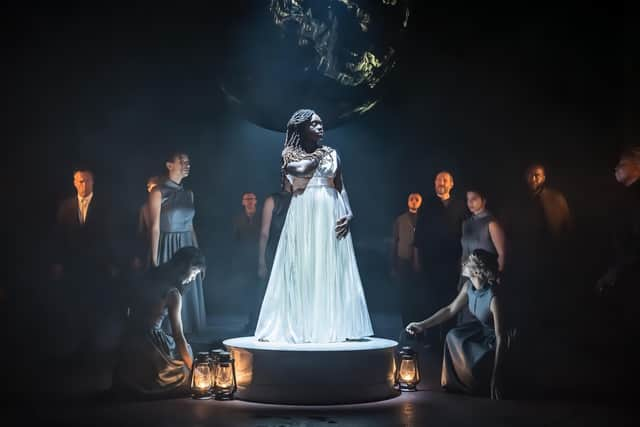

In this production it is very much the women who have the power to resist and transform. Aicha Kossoko as Paulina, Hermione's friend and advocate, is a force of nature in herself as she berates Leontes and later works the deception that finally reveals the truth. The shepherd’s scene is very much female led, almost bacchanalian ritual, in which Perdita (Leah Haile), now a grown woman, is betrothed to Florizel (Lewis Bowes). She is like Persephone, goddess of the spring, soon to be reunited with her mother Hermione, reflecting the goddess Demeter. In the myth, Demeter wreaks revenge for the loss of her daughter by plunging the world into a state of suspension, when nothing grows. So, the gap in time in the play between Perdita’s birth and her discovery is simply there, empty of action, except the misery of Leontes’s guilt.
If this sounds gloomy, and the mythical references obscure, the spectacle isn’t. The stage is beautiful, bathed in deep blue and grey lights, figures appearing out of the darkness upstage and disappearing again. The music is powerful, loud and rhythmic. The dance scene during the shepherd’s celebration is primeval and thrilling. And there is comedy, too, in the figure of the Thief of Time, more generally known as Autolycus, played by Trevor Fox as a wily old tramp and rhymester, selling tales and picking pockets. When he lights a cigarette, it is as if a spark has ignited a shift in the worlds of fantasy and reality.
This show is so jam-packed with references that it would be worth seeing many times to get the full measure of it. But academic technicalities aside, it is a splendid experience and a thrilling piece of confident, exuberant theatre.
The Winter’s Tale runs until 30 August at The Royal Shakespeare Theatre, Stratford-upon-Avon.
Tickets: rsc.org.uk