
100 years of Rugby Radio Station: Our latest feature celebrating historic site
As we mark 100 years of Rugby Radio Station, the Rugby Advertiser is printing a series of features looking at different aspects of the historic site. In this article, local historian Malcolm Hancock and Elly Hemus, Community Development Lead for Houlton at Urban&Civic, explain how they teamed up to add an exclusive extra chapter to a book on the station’s history to mark the milestone.
When it comes to Rugby Radio Station, there are few people who know more than Malcolm Hancock. Born in Rugby, he started working there in 1964 as a ‘youth in training’, and spent his whole career there up until he retired in 2002 as Station Manager.
During his time at the station, Hancock was part of its vital role in communications around the world - something he was keen to see preserved for generations to come.
“The history of the radio station is important because when it opened in 1926 it was the very first transmitter that could reach right around the world,” he explains.

“The GBR transmitter transmitted right around the world at very low frequencies so you could pick it up anywhere in the world which was vital. It was the first time morse messages could be sent from the King, the Prime Minister, to any country in the world.”
That in itself was significant, but the importance of the site didn’t stop there.
“Our frequency also penetrated sea water,” he added.
“In 1966 the Cold War came along and most of our traffic on the big GBR transmitter became submarines and naval ships because they could hear the signals underwater. Also, GBR sent out time signals from about 1928 to put clocks right all around the world - or certainly all round the country – because there was no other way of getting a common time. So ships could pick it up anywhere in the world and set their chronometers right, which was vital for navigation.”
The radio station would continue to be key to worldwide communications, including adding the ability to transmit telephone signals before telephone cables and satellites took over, he explained, saying: “For a long time Rugby was the only connection with a lot of countries in the world.”
News that the site was to be decommissioned was a sad day for those who had lived and breathed the history of such a key site when it came to communications, and Malcolm was
keen to help preserve its history. He went on to work closely with Urban&Civic, the master developer behind the site, to help ensure the historical significance of Rugby Radio Station has lived on.
While the area in many ways is unrecognisable from its time as a radio station, anyone who lives or visits Houlton will notice constant nods to its history, from the imposing Grade II-
listed former Rugby Radio Station building - now home to Houlton School - to road and building names, as well as other artefacts such as the concrete cable stays that remain in some green spaces around the community. “Obviously initially I didn’t want to see the radio station close but it had to happen, so when Urban&Civic started and took a keen interest in preserving some of the history I was very pleased,” Malcolm said. “Rugby was a very big industrial town - lots of other companies were closing and nobody was looking after their old equipment and buildings, or preserving any history, but Urban&Civic seemed willing to try and use some of the history in its construction. The big thing was the conversion of the original building into Houlton School.
That was the most important thing for me because if they were going to spend a lot of money converting a building into a school it was going to be there for a lot, lot longer, so the history was going to be looked after for a lot longer.” He praised the “sympathetic” conversion, which he noted retained enough features to ensure it looked similar to the radio station he had worked in for so long, whilst now having an important new role for the community.
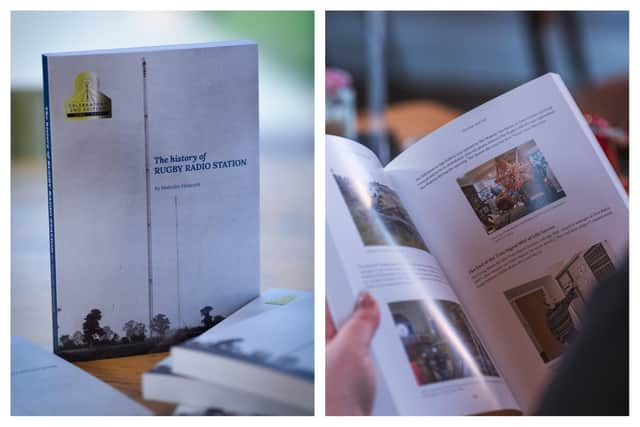
Malcolm also played a direct way in the preservation of the legacy of Rugby Radio Station through his book, ‘The History of Rugby Radio Station’, which was produced in partnership with Urban&Civic.
Initially published in 2017 and sold to raise funds for the local air ambulance, a second edition has now been produced to mark the 100 year celebrations of Rugby Radio
Station - with an exclusive extra chapter adding the site’s most recent history.
That extra chapter has been penned by Elly Hemus, Community Development Lead for Houlton at Urban&Civic, who has described it as an “absolute honour” to have contributed to the latest edition of the book on such a momentous occasion.
“Rugby radio station is where it all began here in Houlton,” she said. “I feel like I learn something new about it every day and it’s always fascinating - from messages it sent to Mars to contributing to the war effort. And now it’s amazing to be the Community Development Lead and work closely with the school doing community initiatives, teaching them about the history, volunteering when they go to the Science Museum and see the tuning coil that used to be in their cafeteria. It really has become the heart of this community and the heart of Houlton and its significance lives on.”
For Elly, being able to contribute to the book was not just a professional achievement, but a personal one too, given the connection she has built to Houlton, its history and its community – something that remains a focus for Urban&Civic as part of their commitment to placemaking and the creation of thriving communities. “To write the story of something I’ve followed and loved for such a long time felt really special,” she said. “I actually have a little mini library at home and sliding that book onto the shelf was a truly special moment for me.”
The publication of the second edition of ‘The History of Rugby Radio Station’ is the latest in a series of events and initiatives by Urban&Civic to mark the 100 years of Rugby Radio Station. It follows the creation of a unique digital tapestry telling the story of the site, which is on show at Rugby Museum and Art Gallery, and celebrations also include special projects from schools in Houlton, and transmissions by amateur radio enthusiasts from the site.
To find out more about 100th year anniversary celebrations, visit RadioStation Rugby:
Connecting you to now and keep an eye on Houlton’s media channels:
Instagram: https://www.instagram.com/houltonrugby
Facebook: https://www.facebook.com/HoultonRugby/