
'I don’t want others to stare or walk away': Rugby mum opens up about son's rare disease

A Rugby mum has opened up about her son’s rare genetic disease that affects only 350 people in the world.
Kelly Vickers-Earll’s son Oscar was born six years ago after a traumatic birth.
He was later diagnosed with a very rare genetic disorder called CTD, which stands for Creatine Transporter Deficiency which is mutations in the SLC6A8 gene.
Now Kelly is speaking out ahead of Rare Disease Day tomorrow (Friday, February 28).
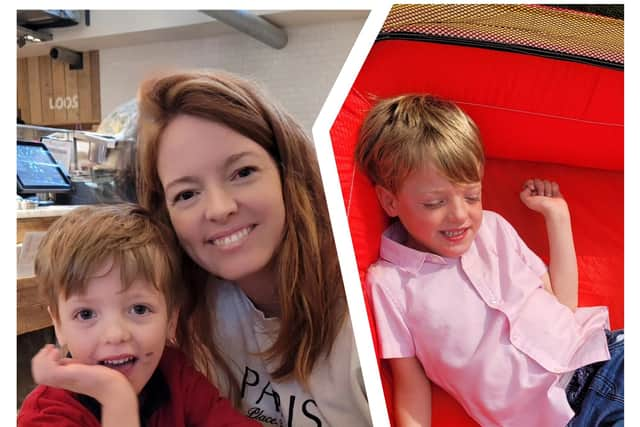

The mum instinctively knew Oscar was different from an early age.
Kelly said: “He was nine months when he sat, 12 months when he crawled and we have never really had the first word. I knew our son was different, like the saying goes 'mum is always right' well, on this I knew it.
"We have been told by medical professionals that there is most certainly a higher number of people with CTD, but it goes undiagnosed, as medical professionals do not know about it, haven’t heard of it so are not tested for it or in general there is not enough testing going on and the public generally have never heard of CTD so may think their child/adult has something else.”
Kelly is hoping that by raising awareness more professionals will become knowledgeable of CTD, hoping one day a cure will be found.
She went on: "As a mum of a child with CTD I want to raise awareness of children with disabilities and make it more socially acceptable. When Oscar makes a noise that is not classed as normal I don’t want others to stare or walk away, if a child communicates in a different way, such as stroking your arm, it’s not because they are strange it’s just a different way of communication and I hope one day this will become socially normal.
"It should not be the children/adults who have disabilities that should try and fit to what is classed as normal socially, everyone should be accepted. Even if people are different compared to whatever is classed as normal, it’s a good thing, it’s really good to be different.”
Creatine transporters move creatine into the cells of the brain and muscles. This is the part which doesn’t work in Oscar’s body. This process is needed to ensure that muscles and organs have enough energy to develop and function.
Kelly said: “Due to the transporter not functioning in Oscar’s body this presents itself in different way, speech delay/non-verbal, hypotonia, autistic traits, ADHD traits, intellectual disability and delayed motor skills. Other symptoms can be seizures/epilepsy and long QT of the heart.”
There are no proven cures for CTD, but Oscar is on daily high dosage medication just in case some elements are passed through the brain barrier.
The family have had countless hospital visits, but say now they take appointments ‘in their stride’.
“Oscar is the one person I know who can walk into a room and make everyone else smile with his infectious smile that is always on his face,” Kelly said.
"He is already changing the world by showing others how to look at the world in a different way.
"He is an inspiration not only to us as parents but to others, no matter what difficulties he is faced with he always has that smile on his face.”