
Rugby astronomy expert's guide to viewing the solar eclipse
A Rugby astronomy expert has shared tips and advice about viewing the partial solar eclipse.
Darek Chalupka said the weather looks promising for the special astronomical event.
He said: “Today (August 12) we’ve got a pretty special happening over Rugby - a partial solar eclipse, with around 91.5% of the Sun covered by the Moon at maximum.
"The eclipse starts at around 18:16, reaches 50% at about 18:35, with maximum eclipse at approximately 19:12, before ending at around 20:06.

"Although we won’t get totality in Rugby, over 90% of the Sun being covered is still a significant eclipse and should be quite a sight. The weather is looking promising too, so hopefully the British weather doesn’t decide to change its mind at the last minute!”
Darek, who has travelled to Spain to witness the event, said for anyone wanting to watch it, the most important thing is having a clear view towards the west.
"Light pollution doesn’t matter for this one - you definitely won’t struggle to find the Sun,” he said.
"The main challenge is that the eclipse is happening quite late in the day. When it starts, the Sun will be roughly 20° above the horizon, and by maximum eclipse it will be only around 12° high.
"So I’d avoid anywhere where houses, trees or other obstacles block your view towards the setting Sun. An open field or somewhere slightly elevated with a good western horizon would be ideal.
"There’s also a really simple trick to work out roughly how high that is. Stretch your arm fully in front of you. At arm’s length, one finger held horizontally is roughly 1°, while an open hand held horizontally is approximately 10°. So at maximum eclipse, the Sun will only be a little more than one open hand above the horizon.”
Darek said the really important bit is safety.
"Never look directly at the Sun without proper solar protection,” he said.
“Normal sunglasses aren’t enough - you need certified eclipse glasses or a proper solar filter designed for observing the Sun. The same applies to cameras, binoculars and telescopes. They need a suitable solar filter securely fitted over the front of the optics.”
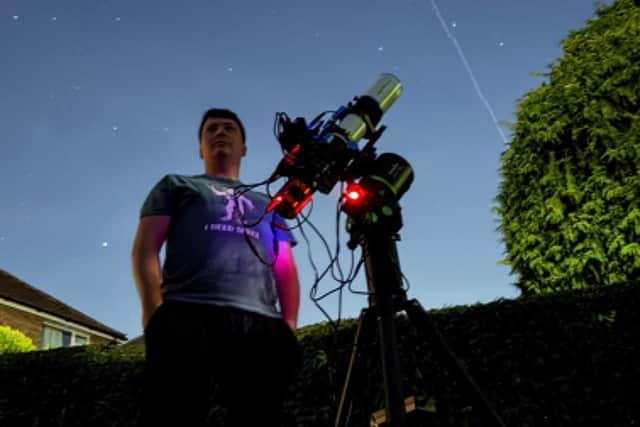
Darek describes astronomy as a hobby that “got a little bit out of hand”.
“Online, I use the name LA7E - pronounced ‘late’ - which is probably quite fitting considering how many nights I end up standing outside next to a telescope,” said the sky enthusiast.
"I started LA7E At Night – Astronomy & Chill simply as a place to share what I’m doing, whether that’s taking pictures, trying to catch something interesting happening in the sky or occasionally livestreaming through my telescope.
"I also run the Rugby Night Sky Facebook group, where I share things that people around Rugby can actually go outside and see for themselves. That’s probably the bit I enjoy most - you really don’t need expensive equipment or loads of astronomy knowledge to start looking up and enjoying what’s above us.
"For this eclipse I’ve taken things a little further and travelled to Spain with my astronomy gear, where I’ll be inside the path of totality. Here the Moon will completely cover the Sun for a short time, and the plan is to photograph and livestream it so hopefully people back home can experience a little bit of totality with us too – weather and technology permitting!
"At the same time, everyone back in Rugby can step outside and look at the same eclipse, just from a different part of the Moon’s shadow.
“Hopefully we all get clear skies!”
Share your eclipse pictures with us. Send to us on Facebook or [email protected]