

By the time the mushroom cloud had dissolved into a fine radio-active mist, two hundred thousand people were dead, many were barely alive, and countless more were disfigured for life.
At around tea-time on 6 August 1945, as the civilian population of Rugby was settling down to enjoy their war-time rations, an atomic- bomb was detonated 580 metres above the Japanese city of Hiroshima, and it changed the world.
By the time the mushroom cloud had dissolved into a fine radio-active mist, two hundred thousand people were dead, many were barely alive, and countless more were disfigured for life.
It marked the beginning of the end of World War two. Nine days later, on the fifteenth of August, Emperor Hirohito broadcast the news that Imperial Japan had surrendered to the allies.
Today, (Friday) we celebrate that day as ‘Victory in Japan Day’ in Japan, it is known as ‘Memorial Day for the end of the war’.
Britain’s war against Japan is sometimes referred to as the ‘forgotten war’ and is often looked upon as less significant than the conflict in Europe. But, according to the Royal British Legion, Britain suffered more than ninety thousand fatalities in the conflict; some in military campaigns in Malaya, Singapore and Burma, but many died in captivity from the harsh conditions of starvation, disease and forced labour.
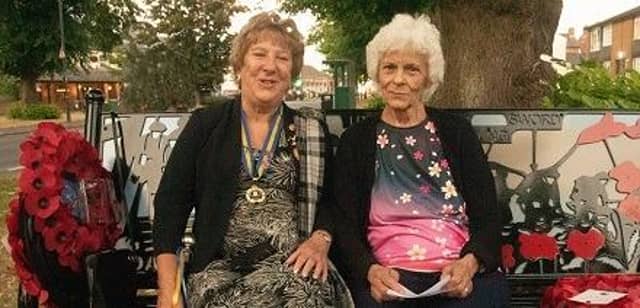
But some, like eighty-seven-year-old Patricia McKay from Rugby, made it through the worst of experiences. She spent five years of her early childhood in a Singapore prisoner of war camp
where the discipline of the camp guards was brutal and unrelenting.
“I can’t remember much about my experience.” she said.
“I was too young to remember. I was three years old when my family was captured and sent to a camp far away from our home. What I do remember is the hunger. We were always hungry; there was never enough food.”
Hillmorton Branch of The Royal British Legion, along with Saint John the Baptist Church,marked the eightieth anniversary of the ending of the war, with a parade through the village.
The event attracted some 200 visitors who lined up along High Street to witness the parade as it passed by.
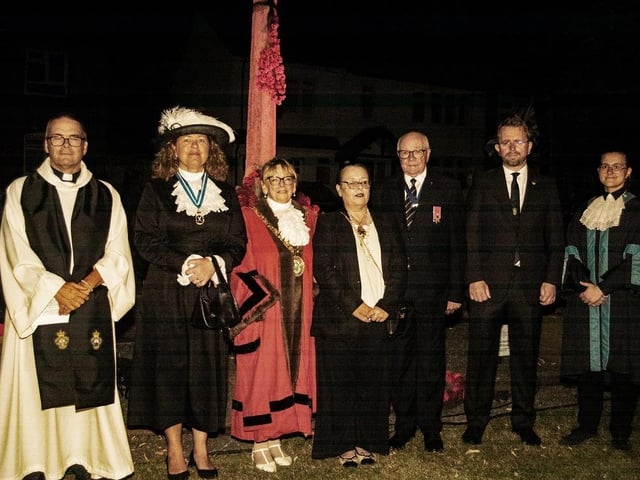
It was also attended by civil dignitaries from town, county and parliament, some in ceremonial dress, who gathered around the war memorial to acknowledge the march-past.
Striding in military fashion, the march-past included serving soldiers from the Gurkhas and 4 Para, members of Service Associations, who marched proudly with their banners held aloft and Sea and Air cadets who set the pace for the remainder to follow. Beating time with familiar war time themes, the Brass Band of Central England led the procession with a selection of marching tunes that kept the parade on the move; until being stood down for the traditional outdoor church service, led by the Rev Steve Gold.
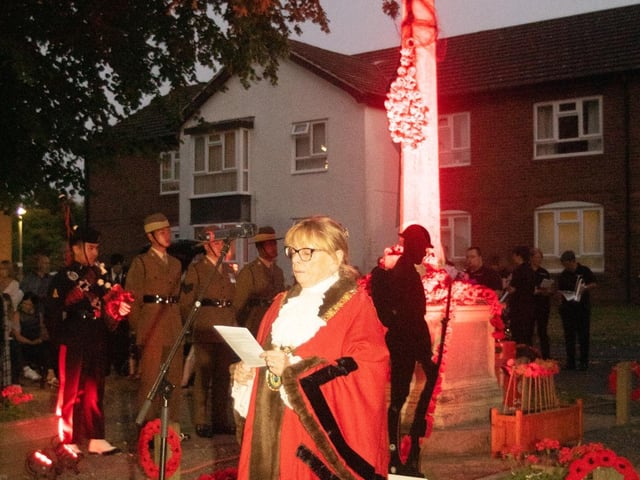
In her speech to the congregation, the Mayor of Rugby, Councillor Barbara Browne, accompanied by her official consort and daughter Elspeth, said: “The service and sacrifice of those who paid the ultimate price for our freedom, will never be forgotten. At times like this, we think about what these heroes might expect from us.
"They may rest in peace, assured we will honour their noble memory.”
5. Hillmorton remembers
The Rev Steve Gold: High Sheriff of Warwickshire, Katen Lynch, MBE: Mayor of Rugby, Cllr Barbara Browne: Mayoral Consert Elspeth Brown: Deputy. Lord Lieutenant, Dr. Eric Wood OBE: John Slinger MP: Photo: Patrick Joyce
6. Hillmorton remembers
Rugby Mayor Barbara Brown gives a moving speech. Photo: Patrick Joyce