
Female high school students earn CREST Award for women’s health science project
Year 9 students at Rugby High School, an all-girls school in Warwickshire, have earned a Bronze CREST Award for their work on a science project in which they explored and examined topics related to women’s reproductive health.
Curriculum Lead for Physics and GCSE Combined Science, Susan Mighall, and Stewart Broadbent, Key Stage 3 Science Co-ordinator, recognised the importance of empowering young girls to be well-informed on these issues and feel comfortable discussing them with peers, family members and healthcare workers.
Too often menstrual education is overlooked or reduced to a footnote within the science curriculum, allowing stigmas around these topics to go unaddressed and girls left uninformed about issues that will affect them throughout their lives.
To tackle this, Susan and Stewart supported Year 9 students to complete group projects exploring topics including the menstrual cycle, taboos around women’s health, HPV, cervical cancer, endometriosis and global healthcare during pregnancy.
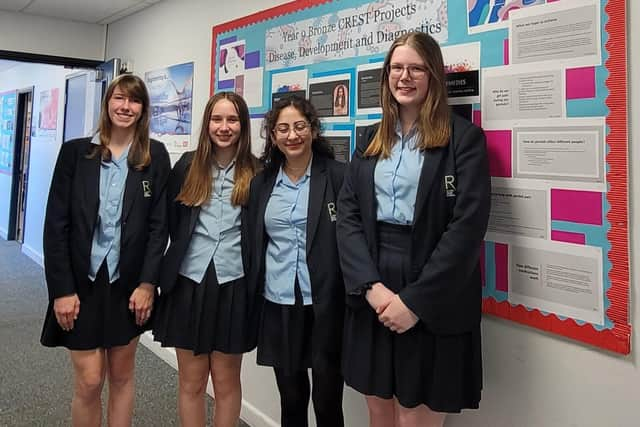

One of the groups completed the ‘It’s a pain’ project, exploring why some women experience worse menstrual pain and the best methods of pain relief, concluding their findings in a final presentation. Another group explored the HPV vaccine, its link to cervical cancer and the importance of the essential vaccine.
To guide these projects, Susan and Stewart utilised the British Science Association’s (BSA) Bronze CREST Awards, a nationally recognised scheme of resources which introduce students to project-based work by empowering them to work like scientists to design and complete a project that addresses a real-world problem.
Project-based lessons are widely proven to help students develop their skillsets and learn to work independently. Additionally, project-based learning has a significant impact on engaging girls with STEM subjects, which is particularly important given the relevance of these topics to the students’ own experiences and wider issues of underrepresentation of women in the sector. By contextualising learning in this way, these projects demonstrate that anyone can be a scientist and relate to STEM subjects, regardless of gender.
Susan highlighted how the resources showcased possible career paths within STEM at a key point in the girls’ educational journeys, prior to them making their GCSE choices. Introducing the girls to the variety of roles available within STEM is particularly important at this age as these decisions can shape their future career paths, helping to build aspirations and encourage more girls to pursue STEM careers.

The teachers noted the growth in the girls’ confidence to discuss these topics and the enthusiasm and sustained interest they showed, with discussions of the subjects extending beyond the small working groups as the girls built their levels of comfort in talking about what can be considered uncomfortable conversations. Completing the projects gave the girls a sense of empowerment as they were better informed and confident about their bodies. They also received a CREST Award for their work, validating and celebrating their learning.
Stuart Broadbent, Key Stage 3 Science Co-ordinator at Rugby High School, said:
“For me, the highlight was the beginning and how engaged the students were by the subject material, and how excited they were to actually start researching and finding out about it. That engagement continued throughout.
“There was a definite buzz through the room of people discovering things all the time and feeling that they knew more about the topics. You wouldn’t have the sustained interest and enthusiasm without that - the feeling in the classroom was of people discovering things.”
A spokesperson for the British Science Association, said:
“Ahead of International Day of Action for Women’s Health (28th May), it is incredibly gratifying to hear about the enthusiasm with which the girls from Rugby High School engaged in their CREST projects on women’s health. Too often are women’s health topics dismissed or overlooked and the hope for these resources was to do a bit to make up for the lack of menstrual health education in the curriculum and tackle stigmas around reproductive issues.
“These resources gave the students the opportunity to take control of their learning whilst discovering how science is part of them, their everyday lives and their futures. Whilst Rugby High School is an all-girls high school, we must not ignore the importance of encouraging boys to engage with these topics and equipping them with the knowledge and understanding to help squash taboos around women’s health issues.”