
Famous Rugby landmark features on Royal Mail's new commemorative stamps
A famous Rugby landmark features on the Royal Mail's new commemorative stamps.
The stamps marking 30 years since the death of Sir Frank Whittle go on general sale today (July 30).
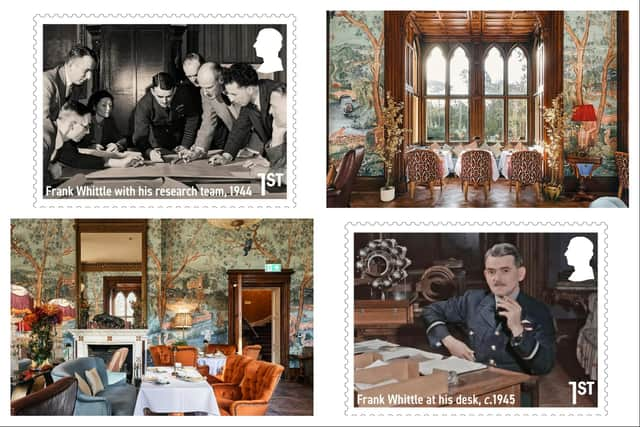

And two of the four photographs used were taken inside Brownsover Hall, the Grade II* listed Gothic Revival house on the northern edge of Rugby that served as Whittle's wartime headquarters.
One of the two shows Whittle at his desk. That desk stood in what is now Boughton’s Tearoom. The Gothic windows and the fireplace visible behind him in the photograph are still exactly where they were.
The building was a hotel and wedding venue for many years before its closure in 2024.
It opened as a hotel once again in December 2025 with 48 rooms following a full restoration led by Farhan Baig of YesFoundry,
The stamps
The issue, announced by Royal Mail on July 23, comprises eight First Class stamps depicting British military jet aircraft, together with a separate four-stamp miniature sheet devoted to Whittle. The miniature sheet marks the 30th anniversary of his death and the development work that laid the foundations for modern military and commercial aviation. The stamps were designed by Webb & Webb Design Ltd and printed by Cartor Security Printers.
Why Whittle was here
Whittle founded Power Jets Ltd in 1936 and set up at the British Thomson-Houston works in Rugby, where the WU engine first ran on April 12, 1937. Development moved to a disused foundry at Lutterworth, and by 1940 the company had outgrown it. Rooms were taken at Brownsover Hall, which sat conveniently between the Rugby works and the Lutterworth test beds and was private enough for wartime secrecy. Whittle moved his office there, taking his senior design staff with him, and stayed until 1946.
On May 15, 1941, the Gloster E.28/39 flew from Cranwell on a Whittle W1 engine. Much of the design work behind it was done in this building.
The room today
Boughton’s Tearoom serves afternoon tea in the room where Whittle worked. During the 2025 refurbishment the room was given a bespoke hand-painted wallpaper by the decorative artist Melissa White, commissioned by Farhan Baig, creative director of YesFoundry. It sets the hall’s history in a Warwickshire landscape — and Sir Frank Whittle appears in it, in RAF uniform, sitting in the treetops. He shares the wallpaper with George Gilbert Scott, who built the Hall in 1857, a red telephone box designed by Scott’s grandson Giles, and the Hall’s own gargoyles.
The hotel’s bar is named Frank’s Bar in his honour and the hall hosted the Whittle centenary dinner in 2007.
Gareth Leakey, managing director at Distinct Group, said: “Most buildings must make a case for their history. We have four stamps going on sale today and two of them were taken in rooms our guests can walk into. People take afternoon tea at the spot where the jet engine was designed, mostly without knowing it. We would rather they knew.”