
Plans to build homes on farmland in Southam could come to fruition after a 28-year push
Plans to build homes on farmland to the south of Southam could finally come to fruition after a 28-year push.
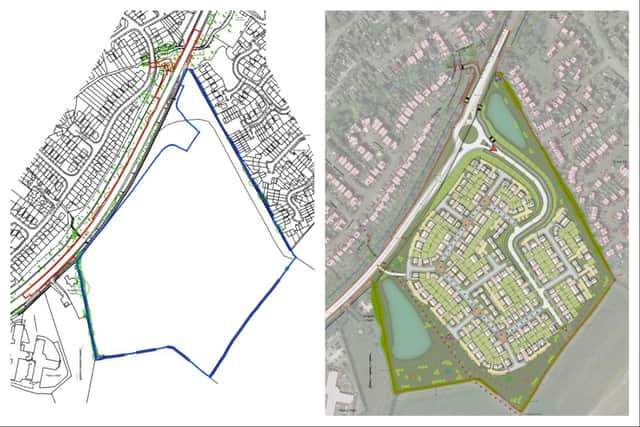
Despite more than 70 objections, Stratford District Council’s planning professionals are recommending that councillors grant outline permission for 217 homes on land adjoining Home Farm, Southam, plus a new roundabout to serve the development off the A423.
The decisions are set to be considered and taken by the council’s planning committee on Wednesday night (August 26, 6pm). Full details of how the site would be laid out and the design of the homes are set to be considered at a later date.
Residential development was initially sought back in 1998 with a 240-home plan then coming forward in 2015. Both applications were rejected by the district and by planning inspectors at appeal.

That second appeal, heard through a full inquiry in 2016, leant heavily on the district’s ability to show a five-year housing land supply, a key issue in the planning balance that is being viewed differently this time.
National expectations have seen the district’s annual housing requirement grow to 1,112 homes per year, leaving it with less than of the homes it needs over the next five years either being built or in the pipeline within that timescale.
It means a titled balance kicks in, affording developers and landowners greater scope to build on sites that are not allocated for housing.
Planning specialists Kler Group Limited, the company that led the 2015 application, have put forward two separate proposals this time, one for the houses and the other for the three-arm roundabout and road crossing.
Councillor Gill Padgham (Lib Dem, Southam South) joined the list of objectors citing those past applications, building on open countryside, a lack of infrastructure to support the new homes and further disruption to the flow of the A423 which she calls “a very busy bypass”.
However, the planning report notes how the district’s lack of an adequate land supply makes this an on-balance decision, affording the benefits of the market and affordable housing significant weight, while economic, biodiversity net gain and public open space benefits are given moderate weight.
It continues: “The adverse impacts in terms of locational suitability, character and appearance, non-designated heritage assets and the associated policy conflicts carry no more than moderate weight. The loss of agricultural land attracts limited weight.
“The adverse impacts of the development would not significantly and demonstrably outweigh the benefits when assessed against (national) policies taken as whole, including those which promote sustainable locations and the provision of affordable homes.”
Councillors will make the authority’s final decision but Kler would have the option of going to another appeal if the plans are rejected.