
Volunteers help rare butterfly habitat thrive beside railway cutting near Leamington
Volunteer conservationists are working hard to restore a rare butterfly habitat beside a railway cutting near Leamington.
Wildlife charity Butterfly Conservation along with staff from Network Rail have been working in partnership at the Harbury cutting, which in was badly damaged by a major landslip in February 2015 causing significant disruption to the railway and impacting a site of special scientific interest (SSSI).
The location was previously used by several rare butterfly species which are now being encouraged to return and prosper thanks to the ongoing work to sow meadow grasses and wildflowers which support pollinating insects.
The latest phase of the project has used a technique known as ‘green haying’, where a wildflower meadow is cut and the seed-rich hay is quickly moved to another site and spread across the ground.
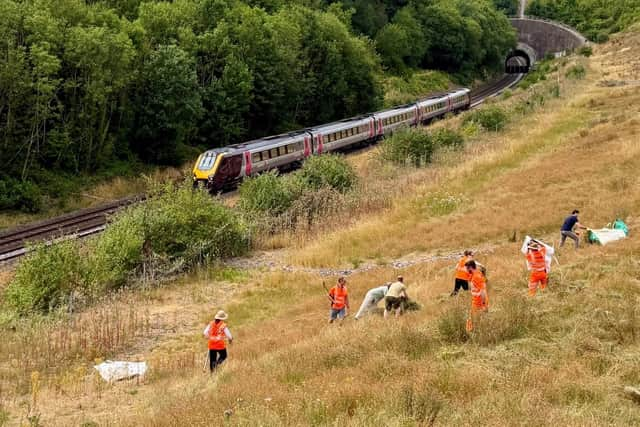

At Harbury, hay from a nearby species-rich meadow managed by Butterfly Conservation was moved by Network Rail to the cutting, where it was unloaded and spread by hand using pitchforks and rakes.
The technique is designed to introduce local wildflower seed to the railway land, improving habitat for butterflies including the Small Blue, Dark Green Fritillary, Grizzled Skipper, Dingy Skipper and Green Hairstreak.
The work builds on an innovative conservation project in which Network Rail previously used a flock of sheep - known as the Harbury Herd - to help manage vegetation on the steep slopes beside the railway.
The sheep spent last winter on the cutting, grazing down competitive grasses and weeds, to give the best possible chance for the pollinators to thrive again come spring of this year.
Jude Ward, environment manager at Network Rail, said: “Harbury has always been a challenging site because of the steep cutting and the important ecology around the railway.
“The sheep helped us manage the vegetation in a more sustainable way, and this green hay work is another practical step in improving the habitat after the damage caused by the 2015 landslip.
“Our partnership with Butterfly Conservation is a great example of how we can work creatively with partners and neighbours to enhance our railway’s ability to act as a wildlife corridor, connecting nearby habitats and species.”
Mike Slater, chair of the Butterfly Conservation Warwickshire branch, added: “It’s great to see this partnership working so well for the benefit of wildlife, and in particular butterflies.
“This project should help reverse the fortunes of some of our rare butterflies, such as the Dingy Skipper and Small Blue.
"I am confident they will colonise this site very soon.”
The hay will sit on the railway land over summer, dropping seed onto the cutting before Network Rail’s flock of sheep returns for winter to graze the land and trample the seed into the soil.
Due to the size of the cutting, repeat applications are expected in future summers to further strengthen the impact and benefits of the work.
Network Rail’s biodiversity work supports its commitment to caring for lineside habitats while keeping the railway safe and reliable for passengers and freight.
To find out more about Network Rail’s work to support biodiversity on Britain’s railways visit https://tinyurl.com/392hw73m
To find out more about the Harbury Herd visit https://tinyurl.com/mv7828rw