
Warwickshire County Council: Reform leadership announces four-pronged policy plan
REFORM UK has launched a four-policy initiative dubbed ‘Recalibrating Warwickshire’ but political rivals were left unimpressed.
Leader Councillor George Finch (Reform UK, Bedworth Central) and his deputy Councillor Stephen Shaw (Reform UK, Polesworth), who also looks after finance and property, held a press conference at Shire Hall on Friday afternoon (August 29).
They released plans for four programmes related to value for money, crime awareness and prevention, transport and special educational needs and disabilities (SEND).
The Crime Awareness and Prevention Programme (CAPP)
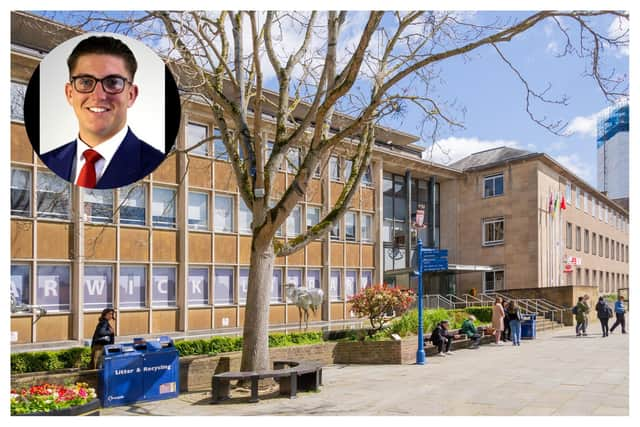

Cllr Finch introduced the crime and safety element with the claim that Warwickshire residents “no longer feel safe in their local communities” with redress “our top priority”.
The Crime Awareness and Prevention Programme will focus on assaults, burglaries, anti-social behaviour and vandalism “with a particular focus on high-crime areas like Nuneaton and Bedworth”.
“The programme will combine public outreach, targeted infrastructure upgrades and the creation of a new community safety unit to coordinate efforts across the council and third-sector partners,” said Cllr Finch who committed to quarterly crime and safety surgeries in each district and borough “led by cabinet portfolio holders and council officers”.
“The purpose of these surgeries is to rebuild trust and transparency and to ensure that we as a council can do better at understanding the concerns of the community,” he added.
A street lighting policy is set to be developed with the potential for additional lighting in areas where it increases community safety.
Reform also plans to allocate £3,000 to all 57 councillors – £171,000 in total – for use at their discretion on community safety prrojects, plus another £250 per councillor to run workshops or events on crime awareness and safety.
“This launch marks the beginning of a detailed planning phase,” said Cllr Finch.
“The next steps will be to encourage partners and secure the necessary funding (from) Warwickshire County Council’s budget and other sources, and consideration of how to build on existing plans.”
A report launching the plan is due to be considered at a meeting of all councillors on Tuesday, September 23.
Preventing and fixing potholes
Cllr Finch announced consideration of proposals to bring the repair of Warwickshire's potholes in-house alongside a prevention programme set to launch in 2026, prompting expectation of “a reduction in the highways contract price and a reduction in the cost of each pothole filled”.
“We hear that what is frustrating residents is not only the dangerous potholes but the poor condition of the roads, which many authorities don’t even classify as potholes,” he said.
“That inevitably led to expensive, reactive repairs.”
He said that 13 per cent of the county’s roads were considered to be in poor condition – “better than many other Shire counties” – and argued “we know we can do much better” through a new strategy that “focuses on prevention rather than cure”.
“This approach will be the best value for money we can get from government funding and reduce the strain on local council tax,” he said.
SEND
On SEND, Cllr Finch committed to working to reduce delays to children receiving education, health and care plans (EHCPs) and threw down the gauntlet to prime minister Sir Keir Starmer to provide a solution to the national funding crisis, insisting councils up and down the land would be “banging at the door asking for more because we will not be in a position to sustain ourselves financially”.
He also called for political rivals to get behind Warwickshire’s push to make a difference.
“When we go to full council, we have to make sure that other parties agree our ways and see what we can do to support families with SEND needs,” said Cllr Finch.
“That is one of the biggest issues I would love to tackle and I call for other groups to work with us to support these children.
"We can’t do it alone, the county council can’t do it alone, we have to tell this Labour government what we are about and put these people first.”
Value for Money programme
On the financial side, Cllr Shaw will be bringing a new Value for Money programme to Thursday’s meeting of cabinet, aiming to create cost savings, promote non-traditional revenue streams and efficiencies to get more bang for the public’s buck.
He said that public money “hasn’t been spent the right way” for too long with many councils taking on large debts and contractors “charging what they like".
He praised the council's finance team for their proactive approach to plans to have “tougher stipulations” in contracts, assess spending on things such as road maintenance, the cost of children in care and home-to-school transport while utilising the benefits of artificial intelligence (AI).
He advocated pursuing ideas such as “moving towards more in-house solutions” like Warwickshire County Council;s ongoing programme of building its own children’s homes and potentially “children travelling in groups (to school) where needs be”, “cutting down taxi spending plus looking at children being in schools closer to their home addresses”.
“I’m going to be completely honest, this will be no overnight success," admitted Cllr Shaw.
"It will take a lot of time and hard work and it will keep evolving to make savings and create new revenue for the council through high-quality services at a more efficient price.
“We are projecting to save £20 million in the first year and up to £50 million dependent on the policies put in place.”
'More questions than answers'
Responding after the conference, Councillor George Cowcher (Lib Dem, Wellesbourne) told the Local Democracy Reporting Service he had expected more detail on the general direction of the council and called Reform's priorities “very selective”.
“It was not comprehensive in any way,” he said.
“It left more questions than answers. There were questions raised about the finances and we have a serious issue to deal with on that front.
“I was expecting to see an overall strategy to deal with that this year. If we are looking to make savings, what are the areas that they will be made in?
“What we got today was a number of areas where we will see additional spending so I imagine that putting even more pressure on the budget with no clarity on where the additional money will come from.”
He also argued that there had been “far too many throwaway, rather glib lines” about the government stepping in with more cash.
“We have to recognise that government has enormous financial pressures,” added Cllr Cowcher.
“The likelihood of them giving additional largesse to local authorities is, I think, unlikely.”
Cllr Cowcher acknowledged public concerns on crime and safety and said it was “helpful” that partnership working was mentioned but added: “The county has a role to play but that wouldn’t be my highest priority in terms of spending more, particularly giving grants to individual councillors to hold meetings. That doesn’t seem to me to be the best use of money.”