
RSC Measure for Measure review: Eye-catching drama meets moral murk on Stratford stage
Nick Le Mesurier reviews Measure for Measure, by William Shakespeare, presented by the RSC at the Royal Shakespeare Theatre, Stratford
It’s not easy to live a good life. In searching for simplicity, we often find complexity. For truth we find lies. For certainty doubt. Measure For Measure, one of Shakespeare’s ‘problem plays’, explores moral conundrums in a world temporarily ruled by absolutes.
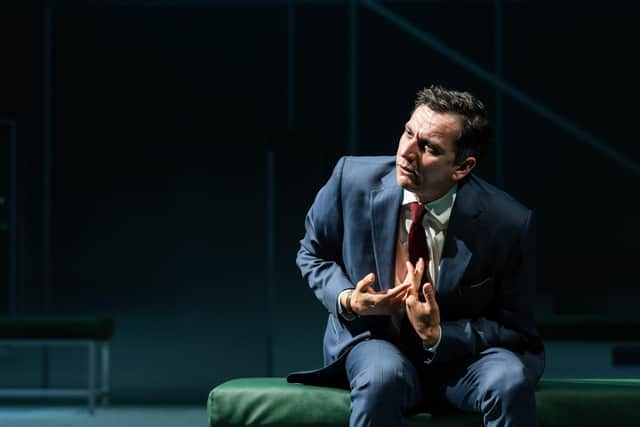

The Royal Shakespeare Company present this tricky play in a stripped-down version, directed by Emily Burns, in a short run. By removing some of the comic low-life characters we are left with a play that is fast-moving and which drives home the central problem that rests upon Isabella’s (Isis Hainsworth) choice: whether or not to succumb to Angelo’s (Tom Mothersdale) lecherous proposition that she sleep with him in order to secure the release of her brother Claudio (Oli Higginson), sentenced to death for fornication outside marriage.
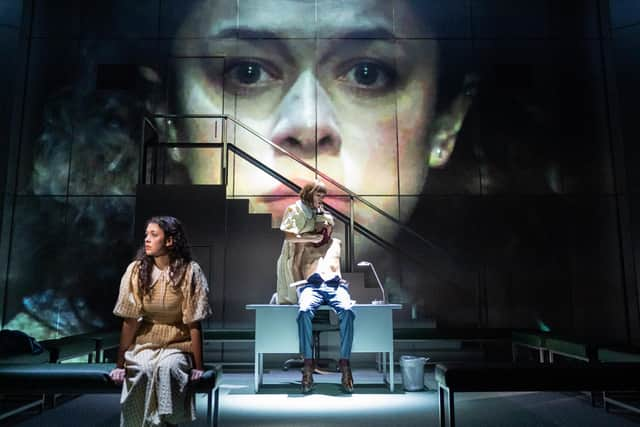
Hypocrisy rules in this environment, here set in a very modern environment of plate steel walls, harsh ambient lighting and colour-coordinated carpets and furniture. This is a world in which power is wielded from behind an office desk, all human emotion rigidly constrained. Here ambition rages unchecked, disguised as morality.
Duke Vincentio (Adam James) decides to test the city’s moral character by handing power to his deputy Angelo, a strict letter-of-the-law man who chooses to resurrect a largely forgotten law that punishes sex outside marriage by death. Claudio has got his soon-to-be bride Juliet (Miya James) pregnant and so must suffer. His sister, Isabella, is about to take holy orders as a nun, but Claudio begs her to appeal to Angelo for his life. She agrees, only to be presented with the ultimatum that reveals Angelo’s emotional confusion. He was once engaged to Mariana (Emily Benjamin) but cruelly spurned her, locking himself up in self-imposed chastity and rectitude. His frustration emerges as a warped sense of morality in which he finds a way to justify what is actually rape.
Duke Vincento, of course, has not fully abdicated but has remained in the city disguised as a cleric. When Isabella chooses personal virtue over life, he hatches a plan with Isabella and Mariana to substitute the latter for the former in an assignation in darkness with Angelo. In a clever, some might find shocking, BDSM twist on the notion it is Mariana who ‘rapes’ Angelo, much to his terror and delight. Returning, the Duke appears to extend the torture of the women by seeming to interrogate them in Angelo’s favour. But all is not as it seems, and the final long scene on the steps of a very presidential display, ends with order, of a sort, restored through sentences of marriage and death. Yet here too, Shakespeare shows the water to be muddy: just how ‘virtuous’ is the Duke in his dealing with dishonour?
The subtleties of Shakespeare’s analysis of goodness and power are not always easy to follow, but then the subject is not, as many would have it, straightforward. This is an engaging production that manages to combine serious ethical arguments with eye-and-ear catching drama, and it brought the audience to its feet in one of the loudest expressions of approval I have seen at the RSC.
Until October 25. Visit www.rsc.org.uk or call 01789 331111 to book.