
Khalsa FC A win George Dutton Cup - beating Leamington Hibernian FC in Kenilworth
The George Dutton Cup Final took place last Thursday at a busy Kenilworth Sporting Ground. Khalsa FC A are chasing league honours and were facing Leamington Hibernian FC's fellow contenders for the Division One title. The game lived up to almost all expectations. The only downside was that it lacked more goals, finishing 1-0 to Khalsa A.

Both sides were playing fast attacking football from the off, with no quarter asked or given. It was at times frantic end-to-end stuff, but the final ball was always lacking and chances were few and far between.
Khalsa finally broke the deadlock two minutes before the break when the ball was played through to Andy Hood, he rode a challenge and from the edge of the box he chipped the keeper who was left to watch as the ball nestled sweetly into the net. The Khalsa supporters went wild.
The second half was very similar with fast-paced football, flowing from end to end, but with little in the way of opportunities. On the hour mark, Hood was substituted, and this signalled a revival by Hibs, who now piled on the pressure.
Khalsa were battered all over the pitch and it became a real dog fight as Hibs grew more frustrated as the Khalsa defence clung on. With the floodlights creating a marvellous atmosphere, and an excellent display by Referee Luke Scale and his assistants Brian Darby and Will Cemis the free-flowing action, and the pace remained until the final minute.
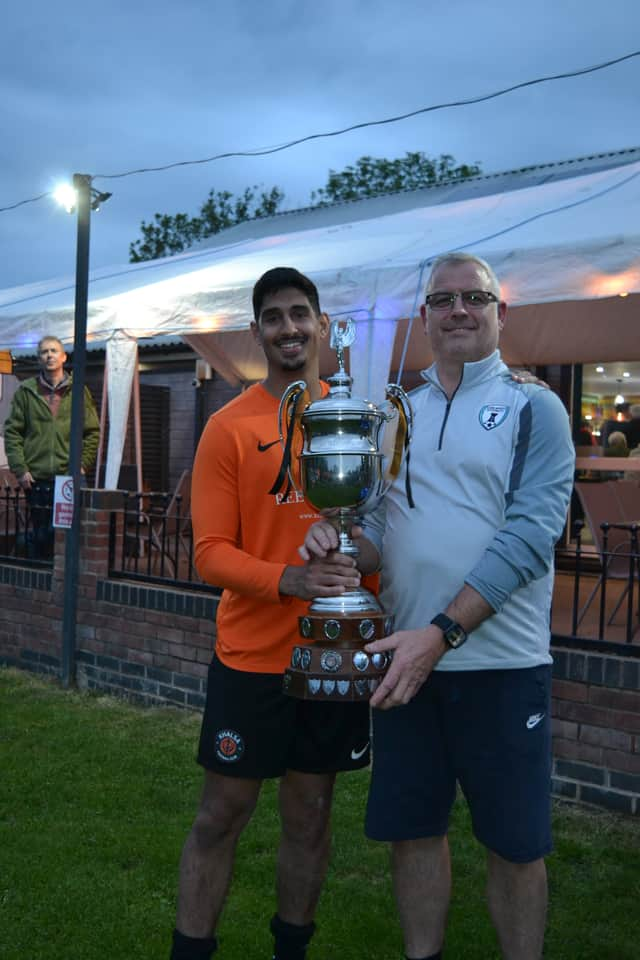
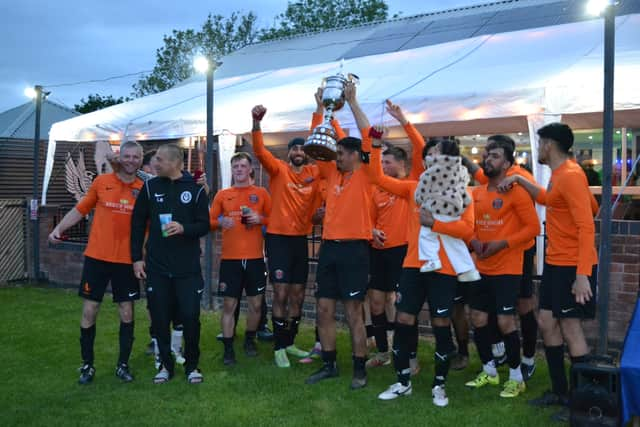
It was an excellent evening’s entertainment all round, as Khalsa FC A won the George Dutton Cup.
The trophy was presented to winning Captain Manjinder Dhaliwal by the chairman of Kenilworth Sporting Club, Scott Harvie.

For some background, George Dutton was born in Stoke in 1895. He moved to Coventry to work as an insurance agent.
He started his refereeing career in the 1920’s. He refereed at a local level in Coventry and Warwickshire. He moved to Warwick and lived on Emscote Road.
The Leamington Referees association was formed in 1921 and George joined, and by 1926 was chairman of the group.
He was heavily involved with all levels of football in the Warwickshire and West Midlands area.

He was chairman of the Warwickshire Combination League and became secretary of the newly formed West Midlands Regional Football League.
He served as secretary of the Hospital Charity Cup. He was also chairman of the FA’s Amateur Cup Competition.
He was chairman of the BCFA from 1955 to 1970.
He was elected vice-president of the Leamington RA in 1966, an office he held until he died in 1976.
He was more famous as a Football Referee and was a senior official in the Football League.
As a Football League referee, George officiated all over the Country at many of the top grounds.
For the 1946-47 season, George was taken off the Football League list as he was too old.
Probably his most famous match was refereeing an FA Cup 6th round tie on 9th March 1946 at Burnden Park: Bolton Wanderers v Stoke City.
The game kicked off at 3pm, but the stadium was too crowded that fans had filled one of the stands by getting in through a broken fence. It was later reported that a father and son had opened a gate allowing thousands more fans into the already crowded area.
The game was stopped to allow the police to clear the pitch. At this point, a police Inspector took George into a corner of the pitch and pointed out the bodies of six people who were deceased. George immediately took the players from the pitch to allow the police to take control. Twenty-six minutes later the game restarted, this included having the touchline re-marked in sand.
The game ended in a goalless draw. 33 people died in the disaster and around 500 were injured. Many said the game should have been postponed but on the advice of the police, it carried on.
On August 24, 1946, George Dutton refereed a fundraising international match between England and Scotland to raise money for the disaster fund. This was held at Manchester City and raised £12,000. The result was a 2-2 draw.
George Dutton was also a local councillor. How he found time for all of these things is anybody’s guess.
George died on February 25th 1976, after a short illness.
The competition for the George Dutton Cup was originally run by the Leamington and Warwick Referees Association, but has more recently been run by the Tracey Thomas Leamington and District Sunday Football League as one of its charity fundraising competitions.