
Warwickshire businesses told what will decide future interest rate decisions
One of the Bank of England’s representatives in Coventry and Warwickshire has explained to businesses the factors that will decide whether interest rates rise in the coming months.
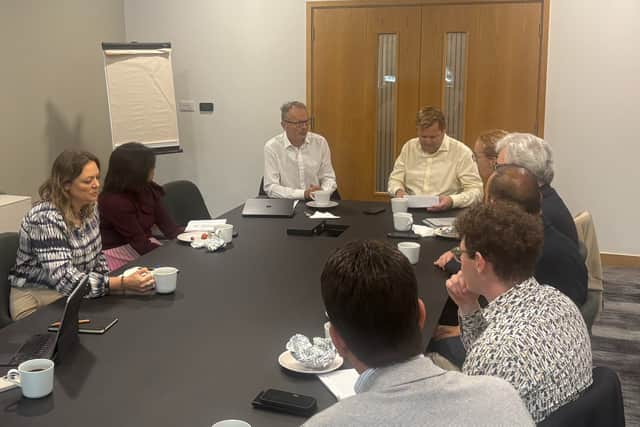

Glynn Jones, the Bank’s Agent for the West Midlands and Oxfordshire, met businesses from a cross section of sectors at an event organised by Coventry and Warwickshire Chamber of Commerce at HCR Law’s offices in Leamington.
He told the gathered firms that the UK economy had proved to be more resilient than forecasters were expecting but that the outlook remained uncertain due a range of global challenges, not least the conflict in the Middle East.
Glynn said the energy price shock was keeping inflation higher than its target of two per cent and that the Bank is watching out for second round effects such as higher wage growth and service sector inflation.
This, he said, is challenging for monetary policy makers given the potential trade-off between wanting to bring inflation back to target but avoid aggressively adding to the pressures on already weak demand.
He said: “As a Central Bank, we’re really focused on is those second-round effects and how this might impact domestic inflation conditions, including wage growth, services price inflation and inflation expectations. That’s what will lead to action.
“It’s a complex picture. You can’t wait until you so those effects to move rates because it will be too late. You need to act in advance of that. But that is also quite tricky, because elevated levels of inflation are impacting demand, which remains subdued.
“The economy has been quite resilient but demand growth is still below its long-term trend rate.
“For a longer period following the financial crisis interest rates remained very low and weren’t going anywhere but over recent years there have been a number of economic shocks and presently there are a range of domestic and global factors to consider.
“There are enormous global pressures on the UK economy which we can’t insulate ourselves from. The UK economy is particularly exposed: we export a lot of both goods and services, but we also import a lot, including food.
“And, reflecting on increasing global volatility, we are now embedding this into our forecast which has a central projection, but also a range of scenarios depending on how these things evolve.”
Businesses fed back to Glynn on their own performance, growth trajectory and plans to recruit and offer pay rewards.
Corin Crane, chief executive of the Coventry and Warwickshire Chamber of Commerce, said: “We are very grateful to Glynn and the Bank of England for the update but also for taking on board what our businesses are saying.
“While the Bank will look at all the data at their fingertips, they really welcome the insights from businesses on the ground. And, it’s fair to say, that it’s a real mixed picture and that’s why it is such a delicate balance when setting rates.”