
Review - Ambition rewarded as Leamington talents shine at Coventry Cathedral
Clive Peacock reviews the finale of Coventry Cathedral’s Black History Month
‘Twas a cold night in Coventry Cathedral as Black History Month 2026 reached a powerful conclusion last weekend with many a musical highlight.
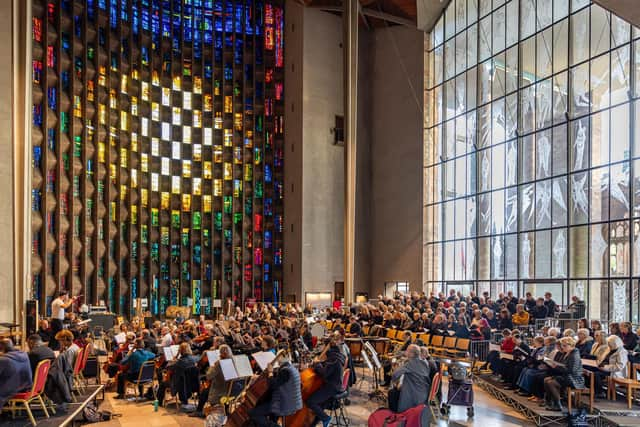

The Cathedral’s Chorus joined forces with Royal Leamington Spa Bach Choir, Divertimento and very capable support of Leamington Sinfonia, to celebrate works by five black composers, some seeking to combine the African musical traditions with those of the new world to create the new African American spiritual music. As the slavery discourse hits the headlines once again, Black History Month is an opportunity to remind new generations that four of the five – Sam Coleridge-Taylor, Robert Nathaniel Dett, Undine Smith Moore and William L Dawson – trace their descents from enslaved African Americans. The fifth, Florence Price, experienced segregation and violence in her early years.
Thanks to the noteworthy efforts of cathedral staff and volunteers, Leamington Sinfonia’s second 2026 visit to Coventry Cathedral, the choir and orchestra seating was rotated 180 degrees with the choir sitting with their backs to the vast West Screen. With nil heating available the choirs sat patiently in place for the first half without taking part. Why? That first half was devoted to orchestral works and songs for soprano solo.
Samuel Coleridge-Taylor’s Ballade in A minor is a young man’s early work full of energy and invention. On the recommendation of Elgar, this work was commissioned by the Three Choirs Festival in 1898. Edward Boothroyd’s strong lead throughout the evening was rewarded with excellent playing by several Sinfonia sections, notably the brass in the opening work, the Ballade. Strings, too, enjoyed the strong long bowing opportunities the Coleridge-Taylor work expects.
Three arrangements of songs from Undine Smith Moore and Florence Price by conductor Michael Karcher-Young introduced soprano April Koyejo-Audiger. Few would disagree with the programme description of April as a “gloriously full-bodied soprano”. Whether it was a voice everyone warmed to is in some doubt. She certainly attacked the top ‘C’s with gusto, and she reached them!
Neil Dawson’s until recently infrequently heard Negro Folk Symphony was an instant success at its première in 1934 but then absent from platforms for 18 years. In recent years its popularity has returned; it is now recognised as a fine example of the excellence of Black American musicians. This work uses the essential spiritual “Go down Moses” which would be heard again after the interval with Dett’s The Ordering of Moses. Sinfonia played the first movement only which included some more fine brass playing, particularly the horn entries and wind contributions which Karcher-Young noted as applause rang out across the nave.
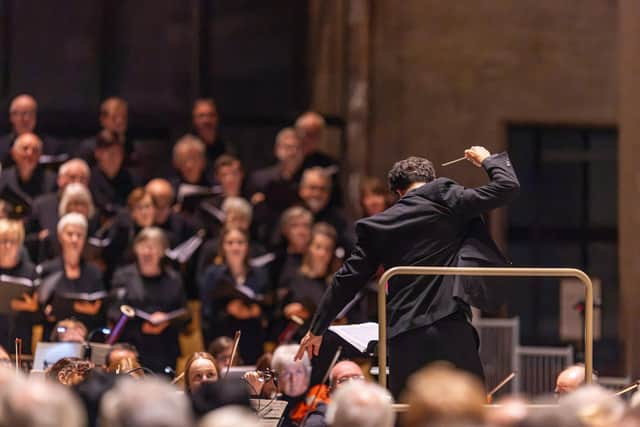
Having been rescued by cups of hot tea, the combined choirs of the Cathedral Chorus and Divertimento erupted into life, reacting animatedly to the encouraging efforts of conductor Jim Bate in their delivery of the 15 movements of Dett’s interpretation of the biblical story of Moses, or as Bate described the work, “the emancipation of the Israelites”. Having attended a choral rehearsal of the work a week before the final performance, it is fair to say a stunning transformation was noted. Solo cello playing set the scene, soon to be joined by more cellos with violas joining in too. That solo cello is an inventive link with many movements.
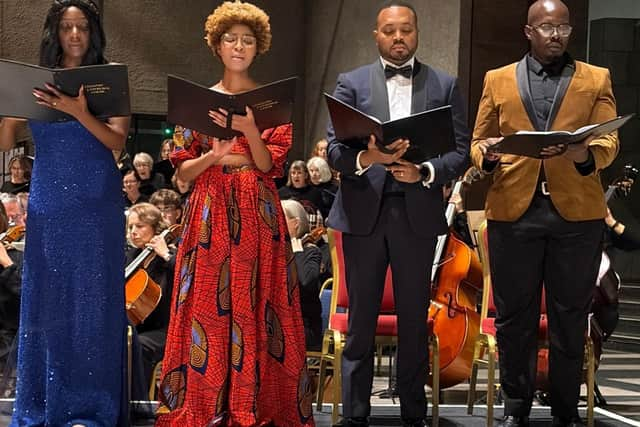
Three of four soloists were well-suited to their roles. Bass Chuma Sijeqa’s strong entries as the Voice of Israel and as the Voice of God were well supported by tenor Christian Joel singing the role of Moses. The massed voices were soon in excellent form and soprano April Koyejo-Audiger was at ease in her role as Miriam. Bate’s continuing enthusiasm and energy bore fruit the longer the work continued, before bringing the work to the most exciting of conclusions, indeed a “full-blooded” conclusion! Full marks to all those choristers and their coaches. This Dett work is a most difficult work, probably Dett’s ‘magnum opus’ in its composition and articulation.
Somehow, with the aid of a new technology, Colin Druce’s organ contributions arrived at the right moments. Sitting at the organ in the choir stalls beneath the Sutherland tapestry, some eighty yards from his conductor, this is one of those most amazing feats!
Many regulars were in the cathedral earlier this year for the first of the two Leamington Sinfonia visits, Mahler’s Symphony of a Thousand. That project was a six-year project; this one, too, was a four-year undertaking. Congratulations to all those who helped to create two extremely memorable occasions.