
Rugby daughter turns father’s experience of aphasia into a lifeline for local families
Watching her once fluent, funny father lose the power of speech to a cruel condition inspired Catherine Cope to help people like him access the help he never had.
Catherine’s father James Buckby – known as Jim – suffered from primary progressive aphasia, a devastating condition that caused him to gradually lose the ability to use and understand language.
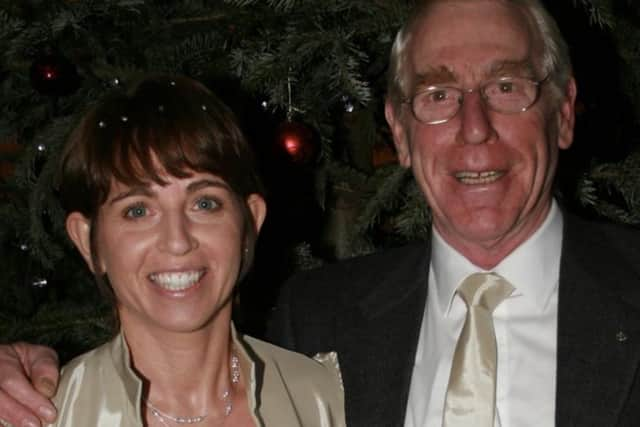

When he died aged 75 in 2016, Jim had been suffering for at least eight years with no support. A decade later, his daughter Catherine has been working hard to create a lasting legacy in her father’s name. Working alongside the charity Aphasia Support, Catherine has helped to set up a brand new Aphasia Café in Warwickshire – a dedicated space where local people with aphasia and their carers can be among others who truly understand.
More than 430 people in the Rugby area are believed to be living with aphasia, a communication disorder often caused by a sudden stroke, brain injury or brain tumour. Speech and language therapy is known to be the best treatment for aphasia, helping people to speak, understand, read and write again following damage to the language parts of the brain.
The type of aphasia Jim suffered from was called Primary Progressive Aphasia, a rare and degenerative form that deteriorated over time. Aphasia does not affect intelligence, but it does affect a person’s ability to express their thoughts, feelings and emotions. Naturally, this has an enormous impact on day to day life.
Catherine recalls the effect on her father, a “fabulous” grandfather, Cub Scout leader and Rotarian who raised money for good causes around the country.
She said: “My dad was always a very personable, friendly, calm, and generous man, easily able to stand in front of an audience and clearly communicate his feelings or thoughts and make people laugh.”
The first time she acknowledged her father was unwell was at her wedding in 2008. She had married before, 18 years previously, and Catherine had fond memories of her father’s speech that day. This time, there were no speeches. Her father was already showing signs of the disorder, and she believes he would have felt very uncomfortable and anxious.
She said: “It started with dad not being able to think of the phrase he needed, tripping up over his words, taking a while longer to register what was being said and respond in an appropriate way.
“Dad became increasingly frustrated and anxious. It was so unlike him, normally very level-headed and always the voice of reason in any difficult situation.
“In all this time, I absolutely believe that for the most part he knew exactly what he wanted to say but couldn’t communicate it.”
For a time, Jim and Catherine used pen and paper to draw and illustrate what he wanted to say.
She said: “He loved playing crib and for a long time during his illness he was still able to play. For me, it was a special and lovely time to spend with him.”
Catherine saw her dad become increasingly tormented by his condition, with feelings of anger and frustration. While he was physically well, his quality of life had deteriorated as he wasn’t able to fully engage with the people and moments that mattered most.
She said: “It was difficult to watch for everyone, including his wife, Janet, my brother Michael, and other family members and friends who were amazing, patient and understanding.”
In all this time, the family had no support. Her father lived with aphasia for at least eight years, and it took many medical appointments before they could get a diagnosis. Even after this they were offered no advice.
Catherine recalls: “Following diagnosis, there was no valuable advice offered or given for his condition and the family felt very much alone.
“We were unable to access any help groups or resource libraries to ease my dad’s uncomfortable and increasingly anxious state.”
When Catherine retired in 2025, she wanted to find a way to improve the “inadequate” care and support for people with aphasia in her area.
That’s when she contacted the charity Aphasia Support, who were looking to expand their service provision beyond Yorkshire.
The charity’s Aphasia Cafés provide a welcoming space where local people with aphasia and their families can share their experiences, meet others who understand and access support from experienced speech and language therapists, who offer practical advice, guidance and opportunities to build confidence in communication.
After raising over £4,000 with support from her husband Kevin, Catherine has spearheaded the launch of Aphasia Support’s new Rugby Aphasia Café taking place at Willoughby Village Hall.
She said: “I wanted to help someone - anyone who might be in a similar position to my Dad - and know we were doing something to ease the pain and stress of living with aphasia.”
“The café will be inclusive, offering people with aphasia and their loved ones a safe space, a community. A place where we will offer a friendly face, professional support, good company, patience and understanding.”
She added: “I could not be more excited for Aphasia Support. I look forward to volunteering my time and helping other families affected by aphasia living in Warwickshire and surrounding areas.”
Starting on November 5, the group will run at Willoughby Village Hall, in Main Street, Willoughby, on the first and third Thursday of every month from 10.30am to 12noon. To join, an online referral must be made in advance of the session.
Visit https://www.aphasiasupport.org/pages/rugby for information.