
The Tempest RSC review - Kenneth Branagh shows what mastery looks like in radiant production
Peter Ormerod reviews The Tempest, by William Shakespeare, presented by the RSC at the Royal Shakespeare Theatre, Stratford
What makes a man cease his striving? Is it wisdom, or is it resignation?
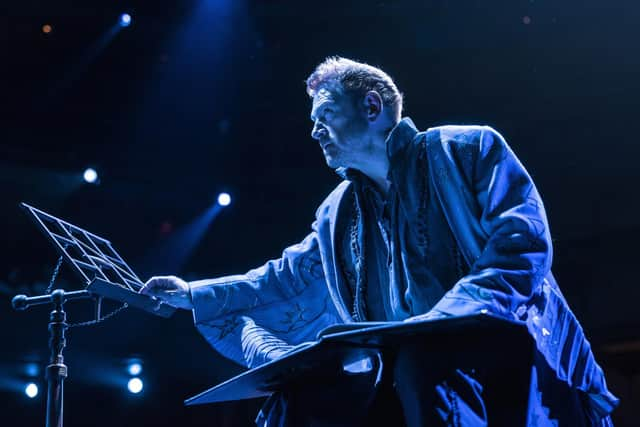

We see both in this radiant production of the last play Shakespeare wrote alone. The aged magician Prospero, the play’s central character, is played with a certain weariness, as if he has outgrown life. His daughter Miranda marvels: “O, brave new world!” His reply hits particularly hard: “’Tis new to thee.”
Yet there is a freedom that comes when Prospero ultimately renounces his magic. And it is a freedom that pervades the show, the freedom of three men with nothing left to prove. One is an actor, one is a director, and one is an artist.
The actor is Kenneth Branagh. He plays Prospero, once Duke of Milan, now exiled on an island. Prospero is versed in the magical arts. The elements obey him: in an act of vengeance he conjures the storm after which the play is named, leaving his enemies shipwrecked. Prospero is depicted here as a conductor: his staff is a baton, his beloved books are musical scores. This is an inspired idea, for we hear that “the isle is full of noises, sounds and sweet airs that give delight and hurt not”. As an actor, Branagh has done everything and won everything. Here, he gives a performance of such relaxed ease that he seems at times to under-act. But this is what mastery looks like. And it leaves room for him to dial things up quite spectacularly when the moment demands.
The director is Richard Eyre. Eyre is 83, a titan of British theatre, and this is his first production for the RSC. He first encountered The Tempest on the radio in 1956, and it has fascinated him since. “It’s hard to distil an allegorical meaning from its ragged narrative,” he writes in the programme. “Better to think of it as a meditation on art and power and freedom.” At this point in his career, Eyre seems entirely uninterested in making any grand statement about the world, or in imposing himself upon the text. And so the play breathes and blooms, soars and settles, quite naturally. Eyre is assured enough to let it be.
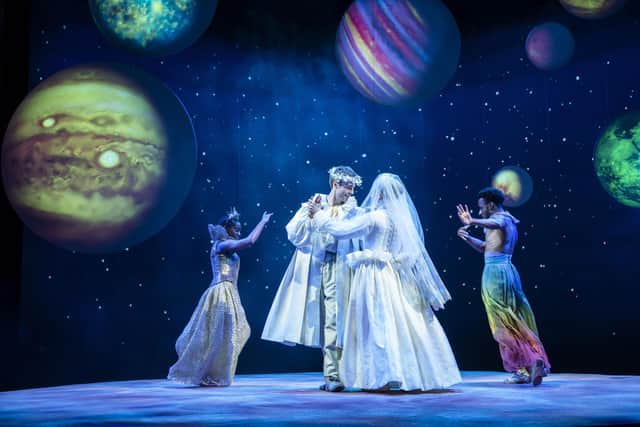
And the artist is Bob Crowley, who has designed the set. Uncluttered, unfussy, unshowy, it is a magical space. Crowley is 73, and is one of the most lauded designers in the business. His work here is so clear, so bold, so simple, that you may wonder what he’s done. And then you realise he’s essentially got out of the way. There is some charming painted scenery and some lovely animation; the lighting, by Hugh Vanstone, is wondrous. Crowley leaves room for everything to look its best.
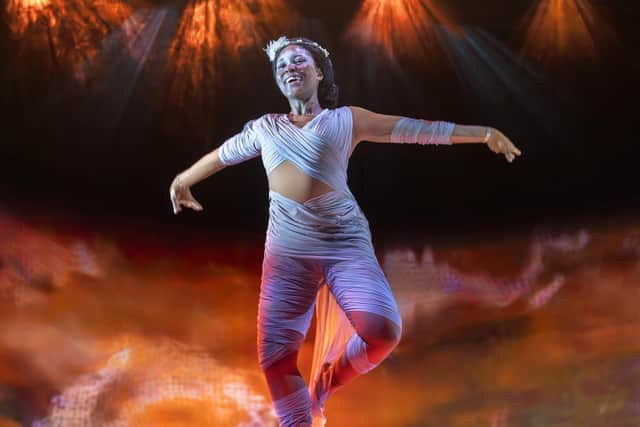
Over it all and in it all hangs Ariel, Prospero’s beloved sprite, played with grace and force by Amara Okereke. Ashley Zhangazha is Caliban, a supposed monster, here a dignified native. Indeed, performances by the whole cast are so strong that Branagh is hardly missed when off stage. The music, composed by Akintayo Akinbode and Stephen Warnock, is essential to the atmosphere, earthy and ethereal.
The spell is cast, and the spell is broken. Prospero snaps his baton and walks away. Is he giving up? Is he giving in? Maybe he’s just letting go – and making way for something new.
Visit rsc.org.uk or call 01789 331111 to book.